
DOSING
DOSING
DOSING

People featured on this page are taking BRIUMVI and have been compensated by TG Therapeutics for their time.
People featured on this page are taking BRIUMVI and have been compensated by TG Therapeutics for their time.
BRIUMVI offers a dosing schedule that may help provide more time for you and less time for your infusion
95% of all BRIUMVI 1-hour infusions were completed in 1 hour† without interruption in clinical studies
†+/- 5 minutes
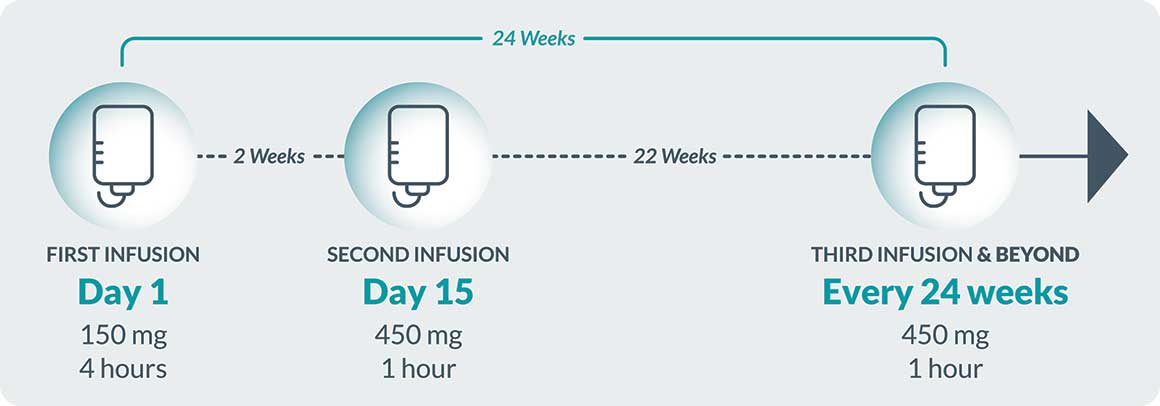
First Infusion
Prior to every infusion, your healthcare provider will evaluate your overall health and answer any questions you have about your infusion treatment.
Also known as your starting dose, your first infusion will last about 4 hours excluding any pre-infusion medication or post-infusion monitoring.
Second Infusion
It will be given 2 weeks after your Day 1 starting dose and will last about 1 hour excluding any pre-infusion medication or post-infusion monitoring.
Infusions (following the starting dose) will typically take 1 hour.
Third Infusion & Beyond
For your first 2 infusions, your healthcare provider will observe you for 1 hour after your infusion is completed.
These will be given every 24 weeks (approximately 6 months) following your Day 1 starting dose. These infusions will also last about 1 hour. Post-infusion monitoring is at your healthcare provider’s discretion and is not required after your third infusion and beyond (unless you have experienced an infusion-related reaction and/or signs of hypersensitivity with your current or prior infusions).
Meaghan, a dog mom and outdoors and fitness enthusiast, shares her perspective on researching treatment options and choosing BRIUMVI.

When it comes to your RMS treatment, consider the dosing and administration options available and discuss with your healthcare provider which option might work best for you
Summary of Select RMS Treatments†
When it comes to your RMS treatment, consider the dosing and administration options available and discuss with your healthcare provider which option might work best for you
Summary of Select RMS Treatments†
| Frequency | Treatment | Maintenance Administration |
|---|---|---|
| Twice a year | BRIUMVI® (ublituximab-xiiy) | 1-hour IV infusiona |
| Twice a year | OCREVUS® (ocrelizumab) OCREVUS ZUNOVOTM (ocrelizumab & hyaluronidase-ocsq) injection | 2 to 3.5 hour IV infusiona,b 10-minute injection |
| Once a month | TYSABRI® (natalizumab) KESIMPTA® (ofatumumab) | 1-hour IV infusion Self-injectionc |
| Once a day or 3 times / weekd | COPAXONE® (glatiramer acetate injection) | Self-injection |
| Once a day | AUBAGIO® (teriflunomide) | Pill |
| Twice a day | VUMERITY® (diroximel fumarate) | Pill |
| Frequency | Treatment | Maintenance Administration |
|---|---|---|
| Twice a year | BRIUMVI® (ublituximab-xiiy) | 1-hour IV infusiona |
| Twice a year | OCREVUS® (ocrelizumab) OCREVUS ZUNOVOTM (ocrelizumab & hyaluronidase-ocsq) injection | 2 to 3.5 hour IV infusiona,b 10-minute injection |
| Once a month | TYSABRI® (natalizumab) KESIMPTA® (ofatumumab) | 1-hour IV infusion Self-injectionc |
| Once a day or 3 times / weekd | COPAXONE® (glatiramer acetate injection) | Self-injection |
| Once a day | AUBAGIO® (teriflunomide) | Pill |
| Twice a day | VUMERITY® (diroximel fumarate) | Pill |
The table above is intended to describe the differences in dosing and administration and should not be considered a comparison of efficacy or safety.
†Includes BRIUMVI and the top 6 most prescribed FDA-approved RMS treatments for patients starting or switching to a new MS treatment (Q4 2021 to Q4 2024 Komodo Claims), combining both generic and branded formulations. Fumarate class includes VUMERITY, TECFIDERA, and generic TECFIDERA. This is not a complete list of all the available treatments for RMS.
aFollowing the starting dose
bDepending on infusion option
cOnce a month after starting dose
dOnce a day for 20 mg dose, 3 times/week for 40 mg dose
Trademarks are the property of their respective owners.
Please see each product’s respective Prescribing Information for additional information including indication, dosing, and safety.
What to expect on your BRIUMVI infusion day
See what BRIUMVI Patient Support can offer you
Hear from the thousands who are taking on RMS with BRIUMVI
Discover how people living with RMS have included BRIUMVI in their treatment journey.

Hear from the thousands who are taking on RMS with BRIUMVI
Discover how people living with RMS have included BRIUMVI in their treatment journey.
Hear from the thousands who are taking on RMS with BRIUMVI
Discover how people living with RMS have included BRIUMVI in their treatment journey.

INDICATION AND IMPORTANT
SAFETY INFORMATION
Who should not receive BRIUMVI?
What is the most important information I should know about BRIUMVI?
-
- fever
- chills
- headache
- flu-like symptoms
- fast heartbeat
- hives
- itchy skin
- dizziness
-
- feeling faint
- swelling of tongue or throat
- trouble breathing
- wheezing
- nausea
- abdominal pain
- throat irritation
- redness of the face or skin
These infusion reactions can happen over 24 hours after your infusion. It is important that you call your healthcare provider right away if you get any of the signs or symptoms listed above after each infusion. If you get an infusion reaction, your healthcare provider may need to stop or slow down the rate of your infusion.
- Infection:
- Infections are a common side effect, and upper respiratory tract infections are one of the most common side effects of BRIUMVI. BRIUMVI increases your risk of getting infections caused by bacteria or viruses that may be life-threatening or cause death. Tell your healthcare provider if you have an infection or have any of the following signs of infection including fever, chills, a cough that does not go away, or painful urination. Your healthcare provider should delay your treatment with BRIUMVI until your infection is gone.
- Hepatitis B virus (HBV) reactivation: Before starting treatment with BRIUMVI, your healthcare provider will do blood tests to check for hepatitis B viral infection. If you have ever had hepatitis B virus infection, the hepatitis B virus may become active again during or after treatment with BRIUMVI. Hepatitis B virus becoming active again (called reactivation) may cause serious liver problems including liver failure or death. Your healthcare provider will monitor you if you are at risk for hepatitis B virus reactivation during treatment and after you stop receiving BRIUMVI.
- Weakened immune system: BRIUMVI taken before or after other medicines that weaken the immune system could increase your risk of getting infections.
- Progressive Multifocal Leukoencephalopathy (PML): PML is a rare, serious brain infection caused by a virus that may get worse over days or weeks. PML can result in death or severe disability. PML has been reported with BRIUMVI. Tell your healthcare provider right away if you have any new or worsening neurologic signs or symptoms. These symptoms may include weakness on one side of your body, loss of coordination in arms and legs, vision problems, changes in thinking and memory which may lead to confusion, and personality changes.
- Low immunoglobulins: BRIUMVI may cause a decrease in some types of antibodies. Your healthcare provider will do blood tests to check your blood immunoglobulin levels.
Before receiving BRIUMVI, tell your healthcare provider about all of your medical conditions, including if you:
What are the possible side effects of BRIUMVI?
Indication
Stay in the know
Sign up to receive the latest updates and resources for BRIUMVI
Join us for a Multiple Sclerosis (MS) educational event near you